 tradella clef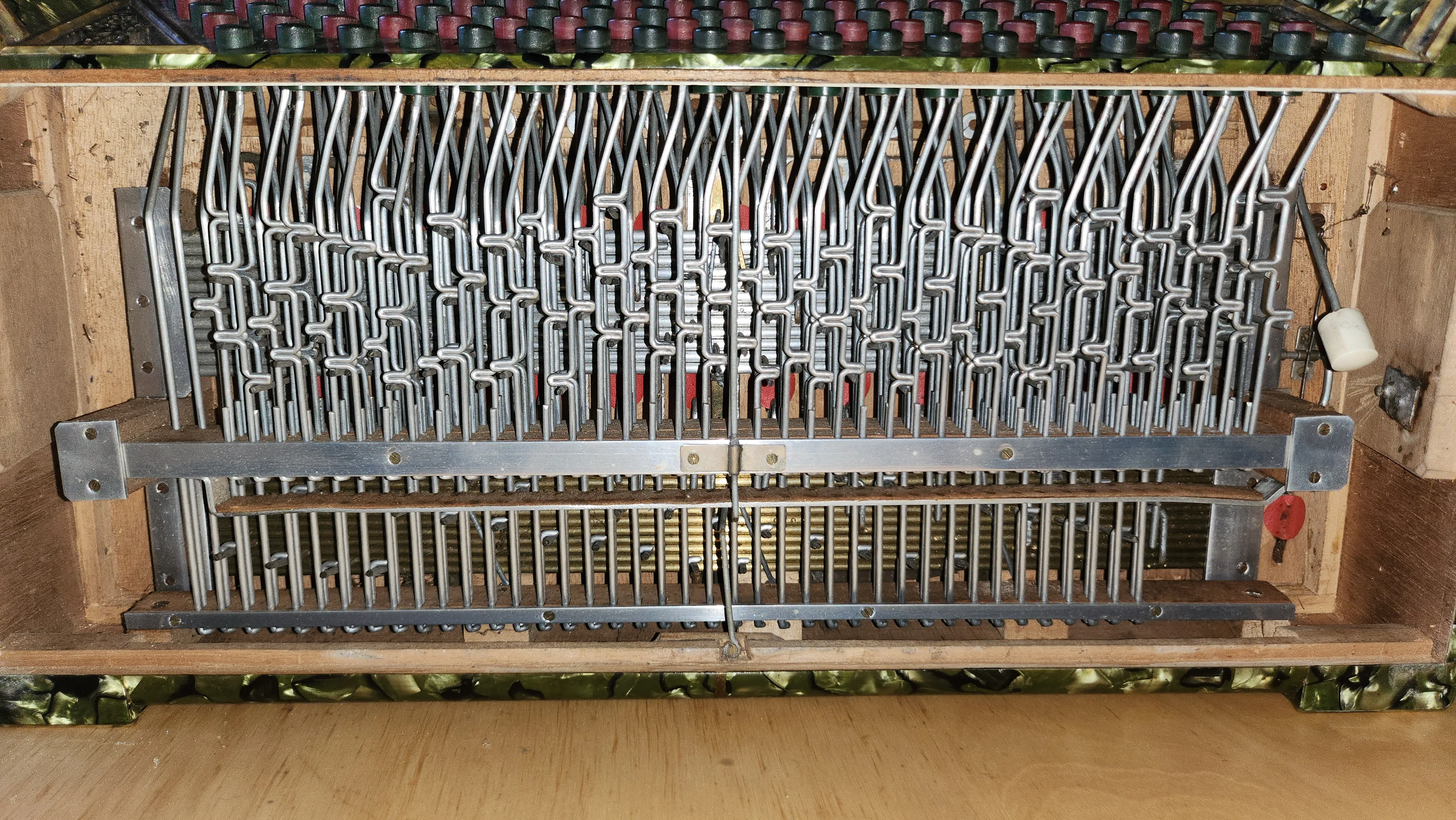
Stradella clef
Notation born of practicality, rooted in music theory.
Stradella bass, accordion’s secret weapon
Stradella bass is the greatest invention in music since Pythagoras realised you can put your finger on the middle of a string to pitch it up an octave. Armed with Stradella bass, accordion should be the easiest instrument. The very layout matches the patterns that real-world chord progressions follow. The most time-consuming part of learning instruments like piano and guitar is learning all the different chords, but we accordionists get to skip that pain: you don’t have to think about what individual notes are in each chord, and progressions are the same shape regardless of what key you play in.
One thing lets us down and makes accordion as hard as those other instruments: sheet music. We use the same notation that pianos use, throwing away the accordion’s advantages. You have to read the notes and recognise the chord like a pianist does, and go backwards: from the separate notes to the chord root and shape, and from there to a single button under your left hand. It’s hard for beginners to learn, and even for advanced players, it ties up brain cells you could be using to play more expressively, if only the notation weren’t creating extra work for you.
There is already a traditional solution for this. You might have seen music like this:—
This solves only half the problem: now you can just read the chord shapes instead of having to work them out, but you still have to read the notes in their piano-keyboard order and relate that to the more natural order of the instrument. Why is that a problem? Look at these notes.
They’re so similar on the page but they’re in completely different places on the instrument. On piano, the sharps and flats implied by a key signature only move your fingers from a white to an adjacent black key, but on Stradella bass, they might move your whole hand to the opposite end of the instrument.
Stradella clef is a new notation that makes reading accordion music as easy as painting by numbers, freeing you up to focus on your performance. Inspired by guitar tabs but tied to the cycle of fifths, it puts nearby buttons near each other on the staff. It’s quicker to learn than bass clef, and less taxing to play at sight.
Learn to play itWrite it with LilyPond
Is notation reform doomed to failure?
Music software guru Tantacrul made an amazing documentary about the history of music notation and some failed attempts to reform it. You could watch it and think that we’re doomed to always suffer with the problems that we have today, with no path to anything better. But his video also gives us three reasons to be optimistic:
- Today’s music notation is part of a millennium-long heritage: but it has evolved continuously over that time. It’s not written in stone, it gradually changes in response to new technologies (like digital printing), instruments (like accordions) and the needs of musicians.
- The main reason reforms fail is that you have to teach the whole body of music practitioners (players and composers) a new thing with a different set of compromises that leave some people worse-off than before. But Stradella clef isn’t for everyone, it’s just for accordionists, so we don’t have to force compromises onto other instruments, and it’s so easy that you can learn it today even if nobody else picks it up.
- The most successful notation reform has been guitar tabs. Tabs are targeted at new players (you can read them without having to learn music first), and they’re just for one instrument. They’re so successful amongst guitarists that some estimates say there are more regular guitar tab users than standard notation. Stradella clef is the accordion equivalent of guitar tabs: it’s instrument-specific, you can choose to learn it instead of bass clef, and there’s no reason every accordionist can’t use it.