 tradella clef
How to read and play Stradella clef
Whether you’re an expert player or a new player who hasn’t learned bass clef yet, after reading this page you’ll be able to play basslines with Stradella clef. All you need is a basic understanding of sheet music, and of the accordion bass layout. (If that’s still new to you, it might help to read this first or have the diagram open at the same time.) If you have an accordion handy, try playing along with the examples.
The clef itself
Stradella clef is marked by this S-shaped clef. You can mix and match Stradella clef and bass clef in the same part, for example for free bass music.
Arrangement of notes
In most sheet music, the notes are arranged in order of pitch. Low notes at the bottom, high notes at the top.
This is easy on the right-hand of a piano accordion, where the notes are also arranged in order of pitch, but on your left hand, the notes follow the cycle of fifths. So in Stradella clef, the notes also go that way. C is on the middle line. Most instruments have a dimple or some other mark on the C bass button.
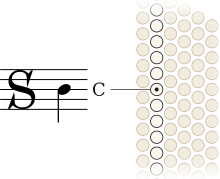
The next button above the C is G, so the next space in the staff above the C is G, and so on.
The E is on the top line, and your instrument might also mark it with a textured button. You can probably guess what happens when you go the other way: they also follow the buttons.
If your A♭ button is also textured like the E, the top and bottom lines are landmarks for your fingers.
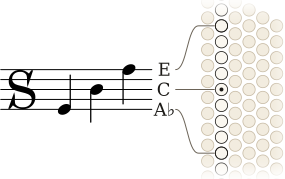
Notice there’s no flat signs in the music for B♭, E♭, A♭. Stradella clef has no sharp or flat signs. In traditional notation, C major is privileged and you need to add sharp and flat signs to get notes from other scales. But Stradella bass is isomorphic (every scale is the same shape) so Stradella clef is too. No sharp or flat signs, no key signature, no accidentals.
In treble clef, you might have learned mnemonics like Every Good Boy Deserves Football and FACE to remember which notes are on the lines and which ones are in the spaces. You may already have noticed that every second button on your bass board goes up a whole tone — thanks to the circle of fifths. Stradella clef has the same property, so you don’t need a mnemonic to learn the notes. For the notes on the lines, start from a marked button (A♭, C, or E) and work up and down in whole tones. For the notes in the spaces, start from the F or G and work up and down in whole tones.
Just like traditional notation, there are leger lines when you go off the top or bottom of the staff. You won’t see them often unless you play in keys with lots of sharps or flats.
Two buttons playing the same note
Maybe you noticed that this example has some repeated notes: G♭ and F♯, D♭ and C♯ are both enharmonic pairs. Unless you’re playing a 72 bass, your instrument has pairs of enharmonic buttons at the top and bottom of the board, and the notation copies it. You don’t have to worry about whether your hand should be at the top or the bottom when you see a C♯: the person who wrote or arranged the music has already thought of it, and the music lets them tell you the answer.
Chords
You can’t base your playing career on just root notes though, there’s a world of chords out there. On the front page the promise is that Stradella clef removes the pain of decoding the chords. So here’s all the standard chords from a six-row instrument:
The most obvious thing is that they use colour to convey the information. The colours are from a standard set that’s designed to be maximally distinguishable for people with different kinds of colour-blindness. Even so, some people can’t see colours at all, so the same information is also conveyed by the shape of the notehead. Here’s what the noteheads look like as whole notes (semibreves) with their unfilled noteheads:
Unlike the arrangement on the staff, this is something you have to learn, so I’ll share the inspiration behind each one and perhaps that’ll help you remember, but you can use whatever associations make sense to you. Like Every Good Boy Deserves Football, you only need the harmonic while you’re practising: you won’t use it when you’ve learned the notation.
Major
Major chords are the most common. They’re straight-up and plain, so of course they’re squares, and people associate blue with businesslike.
Minor
Minor chords can be more spiky, so a red triangular flag marks them out. They’re the second most common after major chords, so these are the most distinguishable colours.
If you quickly scan a sheet of music, those minor chords will stick out, both because of the spiky triangle, and because the red is so distinct next to black and dark blue.
Seventh
The upright triangle here is based on the △ symbol comonly used in jazz sheets to indicate major seventh chords. Sevenths are a bright chord common in blues music, so a bright blue colour fits.
Diminished
Diminished chords are the rarest, so how fitting they should be represented by a diamond, and the pinkish colour that will make sure you see that one’s coming up.
Counter-bass
Traditional accordion notation reuses the legato sign as a fingering hint, to tell you when to play a note as the counterbass, but it still leaves you to work out where the counterbass is: an extra thing to learn, and an extra thing to distract you from playing.
Do these pairs of notes look like they’re next to each other? Do they look like they’re the same shape?
Stradella clef treats the counterbass row like the other rows, so the vertical position shows you the vertical position on the instrument, not what note name you’re playing. The colour shows you which row to play. This is the same music as the last example.
It’s harder to tell that the root D (the third note) and the counterbass D (the last note) are the same note, but it’s easier for the composer or arranger to give you fingering advice for a long run like a walking bass or a scale. There are many ways to play the same scale, and the best way leaves your hand in the right position for whatever notes are coming up next. Making the counterbass an explicit part of the notation means you can use the best fingering without having to look ahead as far to the later notes.
For example, these two runs start with the same notes, but the last note requires a different hand position. You need to look ahead to know what fingerings to use, and it might trip you up when playing at sight.
In Stradella clef, you can’t immediately see that it’s a scale (you will with a little practice!), but you can see from the overall shape where your hand needs to be to play it.
Putting it together
Now you have everything you need to read and play Stradella clef, except time. The rest of the page is about how these ideas come together in real music, or you can skip that and see the same ideas in some example sheets.
Chord progressions
Let’s start by looking at a common I-IV-V alternating bass in different keys. Here’s the old style that you might already know.
Every bar has a different “shape” on the page, even though it’s the same pattern of buttons. There’s one exception: the A major and A♭ major bars look exactly the same, even though your hands are in completely different places. Only the key signature tells you there’s any difference. Traditional notation often makes different hand shapes look the same, and similar patterns look different.
Now let’s look at Stradella clef:
Stradella clef aims to make the same pattern of buttons look the same. Every bar here is the same shape, just on a different note. This makes it easier to recognise, and easier to see when it changes. For example, I like to vary the alternating bass by playing the third (counterbass) if the next chord is going to be up a fifth. Here’s an example of two C major bars into a G major bar:
When all the bars look different, you’ve really got to pay attention to notice that one bar really is different. But here’s how it looks in Stradella clef:
You can see at a glance which note is different. Sheet music doesn’t have repeats and first- and second-time bars just to save paper: it’s because it’s easy to play if you don’t have to search the whole page to find the one bar that’s different.
Chord combining
There are more chord shapes in music than the four common ones the instrument gives you. Advanced players use chord combining to play major sevenths, minor sevenths, ninths, and all kinds of interesting chords. For example, you can play this:
by pressing the C minor and E♭ major buttons together. This is considered an advanced technique because you have to learn what buttons to combine, but it’s the same shape every time. Gm7 is G minor plus B♭ major; Dm7 is D minor plus F major, and so on, always the major three buttons down from the root.
With Stradella clef, this is now a basic technique, because you don’t have to learn it, the music just tells you:
It might look a little weird at first, because it’s something completely new. Still, all you have to do is play the buttons it tells you.
Also, music often wants you to play a root note at the same time as the same chord. Of course, that works too. This might be the first time you’ve seen two noteheads on the same stem in a chord, but it’s common in Stradella clef.
Whether this is useful or not depends on whether the register has a different octave for the root notes compared to the chords: on some instruments they just sound the same reeds, so playing C and C major sounds no different to playing C major alone.
Next steps
Now you’ve learned everything about Stradella clef, you just need to practise.
Download example sheets to playMake your own sheets with LilyPond